August 21st, 2010

Deccan Herald Interview/Review

Lead review
Cinematic imagery
Monideepa Sahu
Urmilla Deshpande’s ‘Kashmir Blues’ is a story written with deep compassion and even the darkest characters are humane, says Monideepa Sahu
Kashmir Blues takes in its expansive narrative sweep the characters’ lives from southern California to the seedy streets of Mumbai, to the charmed circles of India’s rich and powerful, and to Kashmir, strife-torn vale of guns and flowers. Insurgency, socio-political unrest, smuggling, drugs, espionage and conflict cast their shadows. Yet this is a story told with deep compassion. Even the most potentially evil characters can startle by revealing positive human and humane facets. As the author says, “I don’t think either sapphires in my book or diamonds in West Africa are the basis of strife. Nor is religious fundamentalism. It is the inequitable distribution of resources, structural poverty, that sends people into conflict and civil war. Institutionalised injustice.”

Author Urmilla Deshpande began writing relatively later in life, though she always wrote and told stories. “Living in America without a work permit, between doing laundry, cooking, dishes, driving kids around, my mind wandered into strange territories. Writing may have been an escape from the intense grief of my mother’s death, and slow acceptance of her non-existence. Kashmir Blues is an escape, totally unrelated to my own life. It distracted me, yet gave me purpose.”

While there is no direct connection between the author’s life and the book, she chose to write about Kashmir and the divide caused by growing religious fundamentalism. “Maybe it wasn’t flashes of inspiration, “she explains,” but observation, experience, memory, everything I see and read and hear that is fodder for stories. I have to suppress fear of disapproval and consideration for peoples’ feelings and just write. I have been a photographer, but not like Leon, and I have smoked ganja on occasion but didn’t have a drug dependency, I was not adopted or stolen nor did I lose my parents, or child. And, I have never been to Kashmir. It’s a made-up story. Maybe living in post 9/11 America, or editing a book on civil wars had something to do with it, but these are all fragments of what’s around. I guess I just steal from everything.”

The unique Kashmir blue sapphires, the legendary tears of Shiva; the beautiful Kashmiri carpet symbolic of the land and its unravelling with growing strife; the ubiquitous brown dog which seems to follow Leon everywhere; the importance of taking, or breaking free from the spell of drugs; myriad enduring images bind Kashmir Blues. Urmilla Deshpande’s writing displays a cinematic quality. “While writing I feel as if I follow the action,” she says, “in the minds of characters and what happens around them. Like watching a movie and taking notes. I’m not saying it is mystical and ‘comes to me’. More, it’s free association of memories and experiences coalescing into a narrative. I find it hard to go back and say why something happened a particular way. I had to make the changes and address flaws my lovely editor pointed out, but I go back reluctantly. Because then I start reading it as a reader, and inconsistencies and doubts pop up.”

The ‘tears of Shiva’ is made up from stories Urmilla’s mother-in-law told of sapphires bringing bad luck. While the author herself isn’t into religion, superstition, or jewels in real life, she found these ideas interesting.

“As for the brown dog, he’s always around, isn’t he?” Urmilla quips with a mischievous twinkle in her eyes.

Naia and her deep bond with Leon, the photographer with the urge to self-destruct; Samaad the well-educated and far-sighted carpet dealer and warlord in the making; Frank the addicted German wanderer; Viren the diplomat; Saroj who mourns the public loss of her daughter and the private loss of sexual fulfilment; the main players in the story are clearly and credibly portrayed. However, there is an odd note in the rather filmi melodramatic way in which Naia is adopted.

“This incident was one of the major changes I made in the editing process” Urmilla says.“I would have loved to leave it vague with not much explanation. But that might have led to different questions about inconsistency! It’s hard to write for everyone, and I don’t do that. I have to be clear myself. I love that you find it filmi—maybe someone will make this into a filmi film—starring Jeremy Piven as Leon (It has to be Jeremy Piven). Writing is a delight and a pleasure in itself. But it’s short lived. After that, my fulfilment comes from readers’ interpretations. People bring themselves to the books they read—and I am always surprised by what they come up with.”

As for the ideas and inspirations behind the characters, Urmilla shares how her mother once said that characters write themselves. “I thought her a bit mad, but find (as we do about our parents) that she was right. Once characters come to life, it’s hard to make them act in inconsistent ways without putting them in situations where they would break character, or reveal some unseen part of themselves.” Once Urmilla began to write Anne, her depression, her infertility, her fascination with babies and her distress over the street children in Bombay all led up to that moment when she did what she did. One of her favourite people  in the book is Saroj.

“I felt her, heard her voice more than any other. Odd, because I have almost nothing in common with her. I am unable to explain where these people come from or why they do what they do. It is a fast process for me, the actual writing of a novel, but I think life and experience should be counted as part of the process. In which case I would have to say, I’ve been preparing every day of my life to be a writer, and when I was ready, I wrote!”
Urmilla plans to go back to two unfinished novels as soon as she is done with erotic short stories that she took on almost as a challenge from Prita Maitra, her editor. Though she has never written erotic before—not intentionally as a genre anyway – she’s found it “fun so far.” She has also completed editing a book about IIT Bombay’s Hostel four.

August 15th, 2010

Skimmer

I was at the beach with a dear friend who is one of those modern, connected people who keeps his friends and family in touch with his every hour. As I sat in a tired heap on a beach chair after a dose of sun and deliciously warm gulf water, a pod of dolphins rolled by us, displaying their fins and re-energizing us all. I saw a black skimmer slice the water looking for food.

I am in a writing slump – this is not writer’s block really, more of writer’s  laze. I thought a day at the beach would bring me back to my senses, and it did. There is something about the ocean that is both validating and terrifying at the same time – and maybe they are one and the same thing – the simplicity and smallness of being human. We who live on or near the gulf don’t take it for granted anymore, if we ever did. So there is an added pathos to that beauty. I am constantly aware that it is not so large or robust an environment that an act of human greed could not damage it irreparably. I pay greater attention to every little thing, I treat each beach day as if it might be my last.

I returned home and told a neighbor excitedly that we saw dolphins. “I know”, she says, I read it on such and so’s face book page” (she means the friend who was with me at the beach). I am disappointed. I have no beef with the people who transmit their lives to their friends and family, it is a form of communication for them, and they are welcome to it. But I would like the choice to communicate my life in the way I want. I don’t know the solution to this – I am not disturbed by it enough to designate myself a Facebook Free zone, but I do wonder if it isn’t a kind of invasion of my privacy. I mean, there may be people to whom I want to describe my experience myself, and there may be some I don’t want to know that I was even at the beach instead of home trying to meet my deadline.

For those of you who might wonder what a skimmer is – here is a photo. Black Skimmer, Rynchops niger. The skimmer is one of the oddest birds I have ever seen, and one of the most elegant too.

Black Skimmer

August 8th, 2010

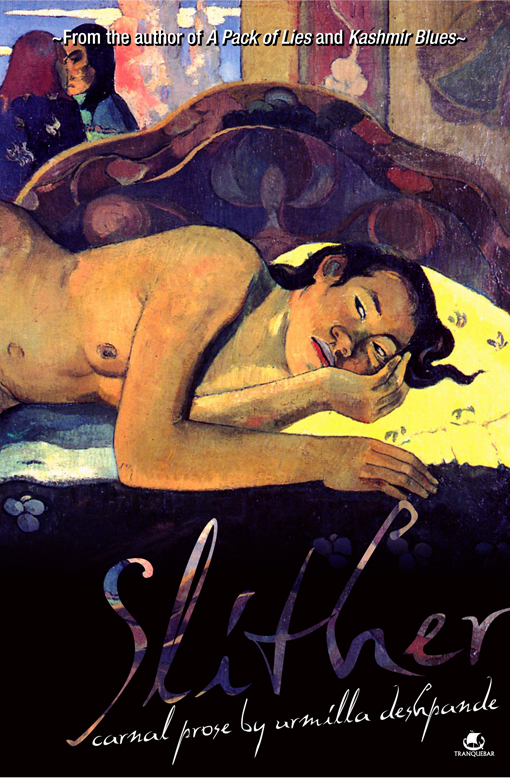
Nice review, full of spoilers, and an odd illustration…

http://www.deccanchronicle.com/tabloids/valley-deep-emotions-995

July 30th, 2010

About to write…

Saint George Island

So, even though I am not writing at the moment, I assure myself that I am collecting material. Looking, seeing, smelling, tasting, eating, listening – it’s all data collection. It will, I tell myself, churn about, or maybe just sit there and ripen, and surely and quickly turn into a clever, or dour, or exciting, or, most hopefully, erotic stream of words that will get me to my deadline. Working/not working – toward a collection of erotic short stories. Erratic.

Kashmir Blues and A Pack of Lies are sitting on Amazon’s shelves collecting cyber dust. I write because I want to. But I do now wish for my writing to be read. I would give it away free, but then, in this world it would be judged as worthless. Also, potatoes and health insurance don’t come free, or art and literature would be too. I’d write for my own delight, and then for the thanks and praise after (abuse would be fine too, it would mean the abuser read my writing). And I’d eat potatoes and be well.

There’s no oil on the beach where I was working last week. They said it was a hundred miles to the west of us, and probably wouldn’t make it there. Trucks and booms lay ready and waiting though, just in case. I collected a lot of sand and salt wind and serenity. Monday morning, there will be words.

July 25th, 2010

Some “news and press”.

Daily News & Analysis

http://www.dnaindia.com/lifestyle/interview_i-could-write-only-after-mother-died_1414150

July 24th, 2010

Kashmir Blues acknowledgements

Kashmir Blues

When I received the pdfs from Westland/Tranquebar for Amazon uploads, the acknowledgements page was missing. This page is, of course, in the printed version of the book, but not in the digital format.

ACKNOWLEDGEMENTS:

Without the dedicated reading of the first draft by my brother-in-law Paul Mitchell, and the detailed reading of the last by my editor Prita Maitra, and her (gentle) insistence on getting it right and not letting me get away with vagueness or laziness, this book would not be what it is. My heartfelt thanks and love to you both.

My sister Meithili Mitchell was part-time editor as well, not always voluntarily, and sometimes even under (vague and unspecified) threats. My love and thanks to you.

Nikhil Khosla, my friend who happens to be my brother-in-law, thanks for sharing your knowledge.

Thank you Lu Vickers, for all your help. Your comments and suggestions were invaluable, and I know the book is better because of them.

My friends who gave me valuable criticism and welcome praise. You make my writing better, yes, but also me: Urvashi Khosla, Richard Bush, Sheila Curran, Joseph Hellweg, Jane Macpherson, Julia and Philip Sura, Robert Draper (who also took out the garbage and changed lightbulbs), Tracy Sumner, Shashi Deshpande, Suhael Merchant.

Sukhi, Tissa, Ashish, and Saheli, your patience and tolerance sustains me, and your encouragement and expectations make me reach beyond my own perceived limits. In writing and in life.

Frank-Udo, I used your name without your permission. This Frank is named for you and not any other. But there the resemblance ends. I did not know you were in the world when I wrote it, just hoped that you were.

July 11th, 2010

Sunday Blues…

sunday blues

July 6th, 2010

Sharmila Phadke in Loksatta

clip from Loksatta

http://www.loksatta.com/index.php?option=com_content&view=article&id=80677:2010-06-25-05-22-38&catid=194:2009-08-14-02-31-30&Itemid=194गौरीच्या मुलीचं पुस्तक

July 5th, 2010

Kashmir Blues

Kashmir Blues, my second book, is available in India. This one’s for you, all you guys who will read it. I hope you enjoy it, and I hope some of you will share your thoughts with me. Because though writing is a pleasure and delight all its own, the feeling I get when you tell me what you got from the book, and what you didn’t, and what you liked and what incensed you, and which people you hated, identified with, fell in love with – all this means you read it.

May 30th, 2010

Break-in

My house was robbed last night. We were all out, when my son got back home he found the back door kicked in, and found some laptops, a game system, and an acoustic guitar missing. It was worth a lot, for the people whose stuff was stolen, it was probably worth much more for those who took it. It was an obviously amateur job – they took cables but not speakers, dropped the controller of the game system in the back yard, and left lots of fingerprints and a shoe print on the door for the forensics guy. We can’t be sure they were the perpetrators, but a group of young men were reported loitering near the house some time before the robbery.

There were different responses from friends, acquaintances, and neighbors when they heard about it. Many were angry on my behalf, which I appreciated, but I didn’t feel particularly angry myself. I felt sad, that there are people who must overcome their better nature and do these things, who are in circumstances that make it necessary to take the risk that is surely involved in what they did. I got a lot of advice – about self-defense, alarm systems, someone even said “we are in a war”. It was unexpected. I was not delighted that my house was robbed, but I am glad that it was not the house of my ninety year old neighbor. I am glad that neither I, nor any of my children were home at the time of the break-in. I am glad that the cat was unharmed.

It’s normal to be angry, and feel threatened, and take unreasonable precautions after such a thing happens. But I feel I shouldn’t forget to ask why. Not why these particular people did this, but why anyone does. I just don’t think there are “evil” people out there who enjoy stealing and being criminals. There might be a few, of course – like those on Wall street. But for the most part, I have a feeling that people have to be desperate to do desperate things.