… Steer clear
of the opaque. Quirkiness is useful,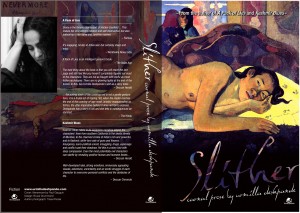
so is translucence. Spank
words carefully. Include
lots of skin, mouth,
tongue. However aesthetic
breasts work the best. Linger.
In her poem ‘How to Write Erotica’, Nitoo Das comes exactingly close to articulating what it is about the genre that makes it so coveted and yet so controversial, and most of all so elusive. Contrary to popular belief, a thick barrier lined with barbed wire separates erotica from pornography. If ‘pornography is the attempt to insult sex,’ as D H Lawrence suggested in his essay ‘On Pornography’, erotica is the attempt to celebrate its roots – desire. The two genres are motivated by entirely different impulses, but it is the degree to which the act of sex is alluded that demarcates the boundaries.
If there is still any confusion, the simplest rule of thumb is the level of facility it takes to dabble in either genre. Place a camera mechanically in front of a masturbating woman and you have pornography. Instead, document the sensation, the rush of blood from clitoris to head as she writhes and combusts and swims in wave after ecstatic wave until her lips contort into an open mouth, until the quivering ceases after the final gasp, the penultimate sigh. Erotica is what you will have produced. Pornography is a cakewalk. It does not necessitate the use of one’s imagination. But to write a single line of erotica from scratch, you must first create the universe.
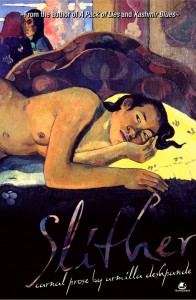
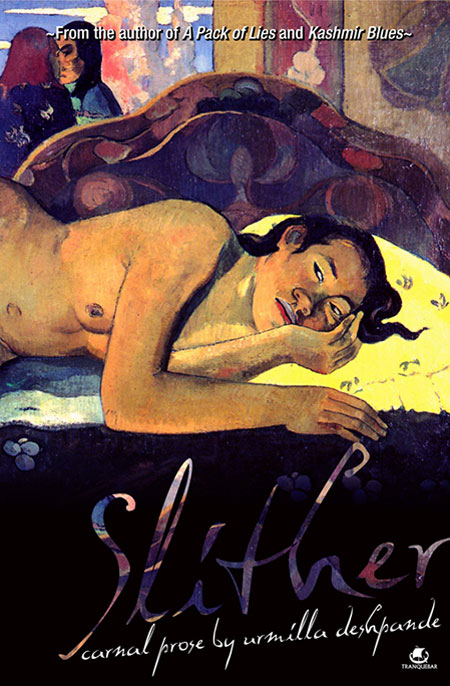
That is precisely what Urmilla Deshpande seems to have done in Slither, her collection of erotic stories published by Tranquebar. The cover defines this body of work as ‘carnal prose’, and with every story a new dimension of this secret universe of flesh and fire unravels. The atmosphere is dense with alternating layers of desire and desperation: a single fertile river that runs underground and bifurcates into diverse streams of consciousness, infusing and irrigating everything it encompasses with passion and intrigue. The landscape is peopled with characters who live ordinary lives and who dabble routinely with the mundane, but who experience the world in all its sensual glory. But Deshpande’s true genius lies in her ability to play with the texture of language, to ‘spank words carefully’ and to create a dialogue between touch and the sensation of that touch – and, often, the longing for it. And finally, her capacity to linger in the afterglow of language so that what arouses the reader is not merely the quirkiness of the situation at hand but the symphony that her words conduct.
For instance, the title story is not so much about sex; the focus is on the impassioned lack of it. A woman of indefinite age tells us about her botanist husband, who is more aroused by Amazon gingers than her. She rants:
And still I loved his hands. I wonder what it is about him that rejects me over and over. It is not that he does not look at me. But it is not with the eyes of a lover that he sees me. It is with the eyes of a botanist. He sees my eyes – humans have two, plants none, so perhaps they do not impress him, though they are, I am told, fine eyes. He touches my skin, but with his fingertips, not his whole hands, through my clothes, not with the delight of knowing I’m right there below that layer but with some practical purpose – to guide me through some forest path perhaps, or stop me as he did that day to watch those snakes. He even lays with me, often enough that I would not notice this disinterest, but not often enough that I felt elevated above Amazon gingers.
The 18 stories spread over nearly 300 pages embody a range of characters who are, more often than not, of Indian descent, though not always located in India. Among the most notable we have the botanist’s wife, who finds herself seduced by a village chief in a village along the foothills of the Himalaya; an emotionally unavailable taxidermist who finds herself attracted to another emotionally unavailable person; a member of a family of spirits who can enter and control people’s bodies, a village girl who grows up to be an internationally acclaimed swimmer and who is desperate to lose her virginity and finally does so – at 50.
‘Goblin Market,’ Deshpande’s retelling of the eponymous poem by Christina Rosetti, is easily the most subversive. Here, the two sisters Lizzie and Laura are lovers, and the goblins in question are ravaging beasts with the power to corrupt one’s innocence.
Laura could not resist the smell of the fruit, and the goblins licking them off her, off her breasts, biting and sucking and grabbing her, and then off her cunt, they gathered around it like creatures at a watering hole, lapping, sucking, squealing and pushing each other, fighting for the juices that flowed from her.
‘Isis’ and ‘Slight Return’ are the two other strongest stories. In ‘Isis’, the narrator, a young writer, gets increasingly obsessed with the title character, a yesteryears actress whom he would keep hearing about through his grandfather, who always speaks of her lustfully. He decides to write a book based on her and finally meets this almost mythical figure, finding himself further intrigued by her grace, her beauty and her missing eye. ‘Slight Return’ is a heartbreakingly beautiful story about Suman, a middle-aged woman and victim of a bad marriage, who finds herself transfixed as she chances upon her daughter clandestinely making love to her boyfriend in the dark. Her reaction is not one of horror or shame; instead, given her own negative sexual history and her experience with rape victims and prostitutes, she finds herself strangely appreciative of her daughter’s sexuality and her ability to articulate it. The act of looking is not voyeuristic; rather, it is tempered by tenderness and wisdom.
Each story in the collection has a personality of its own. Despite the phenomenal range and variety of the plots, you find yourself relating to and remembering the context of each narrative. Moreover, there is a dexterous quality to the language, a stylistic flexibility. Deshpande juggles different techniques of narration, from first-person to third, and each voice is unique so there is no room for repetition or monotony. This is a commendable feat considering what are, in this reviewer’s opinion, the limitations of the vocabulary of the English language, particularly when it comes to describing either sex
or intimacy.
Holy well
While the Subcontinent has a rich history of erotica, most of the pre-modern erotic writing by women has been within the domain of the devotional, by Bhakti women poets like Meera and Akka Mahadevi, the 12th-century saint from Karnataka. Given this history, erotica by contemporary Indian women writers could be read in the same vein as casual sex, an indulgence, writing for pleasure, which is precisely why the Indian moral brigade got its panties in a twist when writers such as Kamala Das started to write the way she did, irreverently and indulgently focusing on her erotic self. Erotica continues to be a controversial genre, which explains most women’s preference for adopting pseudonyms. While it is acceptable for men to brag about their sexual exploits, it is still taboo for women writers. The few women who do, usually hesitate to sign their real names to their writing.
Writers who so much as hint at being sexually experienced – such as Meena Kandasamy, who openly writes about the experience of being Dalit and a woman, and Mridula Garg – often have to bear the brunt of moral hypocrisy. Writing erotica comes at the price of one’s reputation. Ruchir Joshi’s introduction to Electric Feather is testimony. Joshi explains the difficulty he experienced in soliciting stories. ‘One senior Indian writer, who writes brilliant erotics, disdained to even answer my email. Three others did variations of sputtering into their beer, “Me write porn for you!?! No fucking way!” and promptly crossed their legs, all three. One star of the firmament smiled very sweetly and said, “If I find the time, I’ll certainly think about it.”’
Deshpande is possibly the first contemporary Indian author in English to publish a collection of stories devoted entirely to the erotic. In the last two years, though, a host of writers, particularly women, have been appropriating the space of the erotic. Most significant among them is the young provocative and award-winning M Svairini, who writes the rather risqué blog, ‘The Bottom Runs the Fuck’, and who recently published a piece in The First Post in defence of a ‘Masturbat-a-thon’. In a monologue titled ‘Kaliyuga Yoni’, which was originally written to be performed as part of ‘Yoni Ki Baat’, an ensemble show conceived along the lines of Eve Ensler’s The Vagina Monologues, Svairini’s narrator personifies her vagina and simultaneously takes a stand on the much-debated issue about the use of the word cunt or even vagina in erotica.
She [my vagina] doesn’t like the word yoni; in English, it sounds spiritual and soft, new agey, shallow as a henna tattoo.
She prefers cunt, as in wet cunt, nasty cunt, naughty cunt, bad cunt, good cunt, beautiful cunt. Cunt from the Sanskrit word for well, or spring, a deep source: kund, as in kundalini. As in the word for menstrual blood: kundapushpa, flower of the holy well. Red Violent. The taste of birth and death, of origins.
Svairini is also a prominent member of an interesting online collective of Southasian writers that calls itself ‘Shameless Yonis’. Other members include Kama Spice, writer of an erotic trilogy, Kessa’s Pride and Sehra’s Honour and Tia’s War, based in a world where people shape-shift between being human and feline. Aisha Nayar, Sabah Guille and Sheherzade are the other permanent members of the collective. Every month, the blog (www.shamelessyonis.wordpress.com) features a guest writer who similarly pushes the genre to new and exciting heights.
As more and more publishers are waking up to the marketing potential of the erotica genre, more and more women are waking up to its capacity for subversion – this is especially so given the recent success of the Slut Walk phenomenon, with urban women becoming increasingly comfortable expressing their right to pleasure. Not only does it arouse and titillate, erotica also seems to offer women space to either articulate or satisfy desire, while answering 20th-century French feminist Helene Cixous’s revolutionary call to women to ‘write their bodies’.
~ Roselyn D’Mello is a journalist and writer in Delhi.

 My Marathi is good enough to talk to my sister (whose Marathi is worse than mine), and not at all good enough to read the translation.


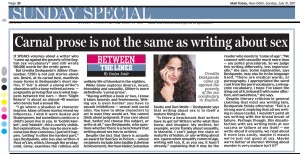 Mail Today, New Delhi, Sunday, July 31, 2011: Between the Lines by Insiya Amir
 http://www.timeoutmumbai.net/books/book_review_details.asp?code=495